
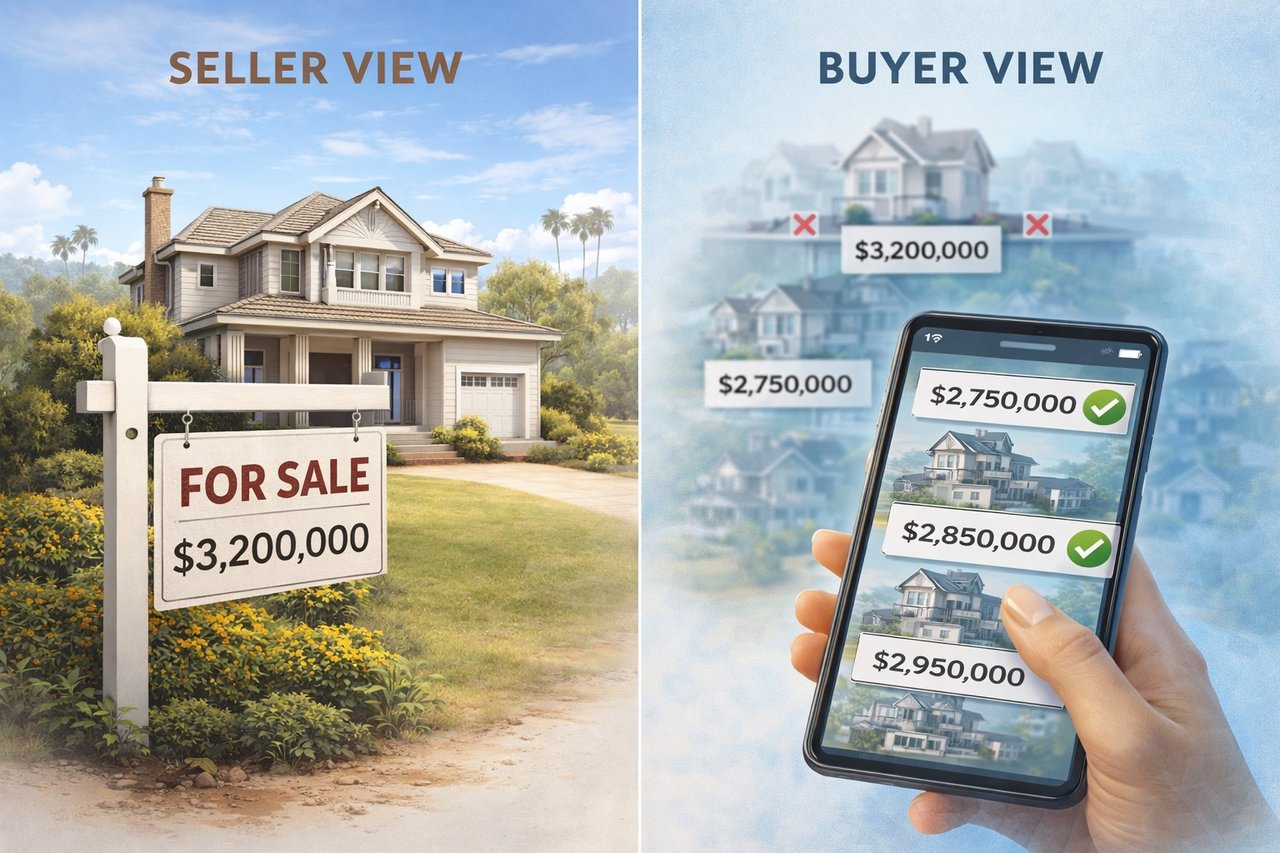
Sellers and buyers do not look at a list price in the same way. It sounds obvious, but the difference matters. Sellers tend to see it as a starting point, something that invites conversation and becomes part of a negotiation. You list at a number, and if it feels high, a buyer can write an offer at a number that makes more sense to them.
But that is not how most buyers actually behave. Buyers see the list price as a filter. When buyers start a home search, they set a price range. That decision happens early and quietly controls everything that follows. It determines what shows up in their search, what gets considered, and what never becomes an option. If a home falls outside that range, buyers do not push back or try to negotiate. In many cases, they simply never see it. From their perspective, it does not exist. A buyer cannot make an offer on a home that is not on their list.
From the seller’s point of view, it feels like buyers should engage, then decide. Maybe they tour the home. Maybe they write an offer below asking. But in reality, most buyers are making decisions much earlier, and much faster. They are scrolling and eliminating. By the time a home would require negotiation, it has often already been excluded.
Even when a home falls within a buyer’s price range, the filtering does not stop. Buyers are constantly asking a simple question: does this price make sense compared to everything else they have seen? If the answer is no, most buyers move on. Not because they are unwilling to negotiate, but because they assume it will not lead anywhere. And when something feels off early, buyers step away rather than engage. This is where the idea that “buyers can just write lower” breaks down. It assumes the buyer is already interested and willing to have a conversation. Most are not. They are looking for the homes that already make sense.
For these reasons, overpriced listings typically do not generate low offers. They generate no offers. From the seller’s perspective, that silence is confusing. No showings, no offers, no clear feedback. The truth is that a list price does not just reflect value. It influences behavior. It shapes whether a buyer feels curiosity or hesitation, whether they engage or move on, and whether they act with urgency or wait.
So, the real question is not whether a buyer could write a lower offer. It is whether they ever get close enough to consider it. Because if the home never shows up in their search or fails that initial “does this make sense” test, there is nothing to negotiate. No offer, no feedback, no second chance. Just a missed connection the seller never even knew existed.
While pricing can create room to negotiate, its real power is creating the conditions for the right buyers to engage in the first place.
Your Trusted Advisors,
Peter and Tregg
Copyright © 2025–2026 Peter Maurice and Tregg Rustad. All rights reserved. Unauthorized use, reproduction, or distribution of this content is prohibited.